ursula: bear eating salmon (Default)
There's an interesting review of Crossing the Finish Line: Completing College at America’s Public Universities at the MAA website. Bressoud writes:

The most interesting observation made by these authors [William Bowen, Matthew Chingos, and Michael McPherson] is the importance of the selectivity of the university. It is not surprising that the more selective the university, the better the graduation rate. What is surprising is that this effect is still substantial even when controlling for SAT scores and high school GPA. At the most selective flagship universities, a student with a combined SAT score between 1000 and 1100 and a high school GPA between 3.00 and 3.33 has a 72.5% chance of graduating within six years. As selectivity decreases, so does the probability that this student will graduate within six years. It drops to only 53.5% at the least selective state universities.

The evidence is that more selective universities really do offer a better education. Higher expectations from faculty and peers, better educational resources, and more complete financial aid are certainly among the factors at play. The authors found evidence that overmatching (going to a university where one’s academic record is near the bottom of those accepted) still improves the probability of graduating within six years, and undermatching (choosing a less selective university when fully qualified for a more selective one) seriously decreases the probability of graduating within six years.
ursula: Gules, a bear passant sable (bear)
In the Society for Creative Anachronism, one can register medieval names and heraldic devices with the College of Heralds. Here's what the Governing Documents of the Society say about the rules the registration process should follow:

Standards of difference and other rules: Laurel shall define standards suitable to the
type of item to be registered, and apply them uniformly to all such submissions. These standards shall be
designed to support the historical re-creations of the Society and to provide sufficient difference from names
and armory registered within the Society to avoid undue confusion, to avoid the appearance of unearned
honors or false claims, and to provide sufficient difference from historical or fictional personages to prevent
offense due to obvious usurpation of identity or armory. Members are encouraged to develop unique,
historically valid names and armory.


Under the current rules and policies, anyone who wishes to participate in the registration process must submit a unique name. (Some historically invalid names are still registrable, but "insufficiently unique" names are not.) The name is required even if one only wishes to register a heraldic device. Registering a name costs about $10 (the exact amount varies from kingdom to kingdom) and takes about nine months. Registering a device is another $10 or so.

One of the reasons that the SCA is attached to the unique name system is that the current registration system depends on paper files organized by this unique registered name. (There are other reasons, of course; a discussion of some of them can be found at the Campaign to End Name Uniqueness, and a more complete view may be obtained by joining the SCAHRLDS mailing list and browsing the archives.) This post proposes a partially computerized filing system. I want to describe why such a system is technically feasible and would allow for greater flexibility, including re-evaluating the "registered SCA name" and "unique SCA name" requirements, if we wish to do so.

gory details )
ursula: Gules, a bear passant sable (bear)
In the Society for Creative Anachronism, rulers of a kingdom are chosen by tournament. Each entrant in the tournament must designate a person as "inspiration", who will serve as consort if that entrant wins the tourney; fighter and inspiration must be of opposite sex. Sovereign principalities must have one prince and one princess. Baronies may have one baron, one baroness, or a baron and a baroness, but may not have two ruling nobles of the same sex.

Debate about this policy within the Society generally follows the lines of the gay marriage debate. Supporters of the status quo often add that there's no historical basis for two men or two women in a romantic relationship serving as rulers of a medieval kingdom; opponents of the status quo concede this point, but argue that the policy should be changed anyway, for reasons of basic fairness.

I believe that the gay marriage analogy is flawed, for a simple reason: there is no requirement in the SCA, tacit or explicit, that ruling nobles have any sort of romantic or sexual relationship. If Duke Hypothetical, having divorced Countess Mundania, chose to fight for his grown daughter Lady Hypothetica, the populace's response would be, "Why, isn't that sweet!" not "Incest is disgusting! I can't subject my children to this filth!" I've heard young men advised to choose a long-time SCA member, someone old enough to be their mother, as inspiration (to provide grounding experience to a reign). And I've known multiple pairs of ruling nobles and fighters/inspirations who were not involved romantically and not ever planning to start.

Thus, the appropriate historical question is not "Did two men or two women in a romantic relationship serve as rulers of a medieval kingdom?" The appropriate question is, "Did two men or two women ever share ceremonial rulership of a medieval kingdom?" (I specify ceremonial rulership since, in the Middle Ages as in the Society, the precise balance of real power varied based on time, place, and circumstance.)

Did two men or two women ever share ceremonial rulership? Absolutely! Those of us raised on English fairy tales often assume that a king's oldest surviving son must inherit the kingdom; but in much of medieval Europe, succession by primogeniture was neither obvious nor inevitable. Kings, counts, dukes, princes, and emperors often chose to crown a successor while they were still alive to pick one. The chosen co-ruler was often a son, brother, or spouse of the first ruler, but not always: sometimes an ambitious person finagled a co-rulership, and sometimes co-rulership solved a territorial dispute.

A random selection of co-rulers in medieval Europe follows.


  • In June 1170, Henry, the second (and then oldest surviving) son of Henry II and Eleanor of Aquitaine, was crowned king by the Archbishop of York. He is generally known as Henry the Young King; since he died before his father, he never reigned alone.
  • French kings who ruled with their fathers include Hugh, son of Robert II (eleventh century), and Philip, son of Louis XI (twelfth century)
  • Several of the English kings of Kent ruled jointly with fathers, sons, brothers, or nephews.
  • Harold Hardrada forced his nephew Magnus the Good to share the kingdom of Norway with him.
  • In the Italian principality of Capua-Benvenuto, brothers as well as fathers and sons shared the title of prince (The New Cambridge Medieval History notes, "On one occasion, very briefly in 939-40, this meant that there were no less than four persons using the princely title: Landulf I, two of his sons and his younger brother, Atenulf II.")
  • The German region of Oels-Cossil had brothers ruling as co-princes in the fifteenth century.
  • A thirteenth-century treaty made Andorra a principality governed by two unrelated co-princes, the Count of Foix and the Bishop of Urgell.
  • In the tenth-century, the duchies of Naples and Amalfi had father and son co-dukes.
  • Father/son pairs served as co-counts of Flanders (twelfth century), Toulouse (tenth century), and Macon (tenth century).
  • Pairs of brothers shared countship in medieval Catalonia (see Ch. 8 in The Experience of Power in Medieval Europe)


I have listed western European examples above. In the Roman empire, and later in the Byzantine empire, multiple emperors were quite common: examples include Justin and Justinian, as well as the two empress plus emperor combination of the sisters Zoe and Theodora together with Zoe's husband Constantine IX. (See
Byzantine Empresses: Women and Power in Byzantium.)
ursula: Gules, a bear passant sable (bear)
Since we've moved to a warmer clime, I have been wearing my red fifteenth-century dress without the black overgown more often. I have a hat to match the gown, but it isn't suitable for hot weather, so I have been looking at the veils worn by women of smaller means in France and Belgium in the fifteenth century.

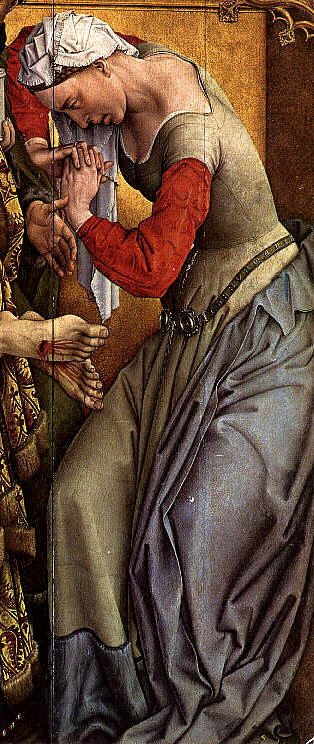
The June image from Les Très Riches Heures shows two women, one wearing a rectangular-ish veil tied at the nape of the neck and hanging to her waist, with some hair hanging loose down her back. The other woman has a more rounded-looking veil. It looks like the woman on the right in this painting by Rogier van der Weyden has one cloth tied tightly around her head, and then another veil pinned to it. Another painting shows a woman who may have attached her frilled veil to her braids.

Does anyone have a favorite method for anchoring a fifteenth-century style veil, or a good source for veil pins? If you have made veils for this period, what size and shape were they?
ursula: bear eating salmon (Default)
The Claremont libraries have a digitized edition of Shelley's friend Edward Ellerker Williams's sketchbook:

http://ccdl.libraries.claremont.edu/collection.php?alias=joe

(Click on the image to see a list of the book's pages.)

Williams was a retired Navy officer; he, Shelley, and another Englishman died when Shelley's schooner was caught in a storm. The notebook has drawings of ships from different countries & Shakespearean characters, pressed flowers, fragments of verse.
ursula: bear eating salmon (Default)
I made corn and avocado salad for dinner the other night, since now that we live in California all the non-bacon ingredients are available and in season. The side dish was cornmeal waffles. It turns out that although I'm often skeptical of cornbread, I really like the extra crunch of cornmeal waffles. (I like my waffles crispy to a fault, which may say something about the normal modes of our family waffle maker when I was small.)

This was the first time I've ever cooked bacon. At the faculty meeting yesterday, one of the professors was explaining to my neighbor that since reading The Omnivore's Dilemma he has vowed to eat more vegetarian meals; I feel myself running against the cultural tide, beginning to be a non-vegetarian cook (though I should note that my bacon was ethically produced & lacking in nitrates or nitrites). I didn't cook it long enough alone, I think, since it never crisped the way I hoped for-- though in the end crunchy corn vs. soft avocado was enough in the way of contrast, and the smokey flavor was a bonus.

Variations: I did add a bell pepper with the corn, since I was low on corn & tomato quantities. If I try this again and have the bell pepper, I may leave it raw. I don't think the bacon was actually necessary; mushrooms seared & deglazed with a splash of red wine, or mushrooms with smoked paprika, or chopped Lapsang-Souchong tea eggs would all substitute nicely.
ursula: bear eating salmon (Default)
We made it to Claremont last night, and are now off to find breakfast.
ursula: bear eating salmon (Default)
Pandora's Star by Peter Hamilton is a nostalgic return to the sort of old-fashioned science fiction where Mankind explores the stars in cool spaceships and battles aliens. It also switches viewpoint characters every few pages, is almost a thousand pages long, and ends in the middle of the story (the ultimate cliffhanger is weirdly parallel to the end of Colour of Magic). This was a Christmas present from a friend of mine, and I can see the motives for the recommendation: the interstellar train network is fun and unexpected, and when the evil alien bent on universe-domination (and sadly in need of some Loraxian consciousness-raising) finally makes its appearance c. page 500 or so, it's both interesting and rather quaint in its single-minded destructiveness. By the end of the book I did sort of want to know what happened next. At the midway point, though, I was only sustaining my interest by writing mental reviews and counting characters who weren't sex objects . . . because unfortunately, Pandora's Star is the sort of old-fashioned science fiction that thinks it's really progressive, but seems to have missed certain basic cues. One wonders, for instance, why the Afro is the only hairstyle that has never become fashionable again in three hundred years, or why the environment-obsessed multibillionaire decides, when founding his own town, that it should be reachable only by road (on a grade too steep for trains) and that residents should live in single-family homes each with yacht, dog, and (electric) car.

I found the sexual politics particularly distracting. The following passage is memorable. Patricia, aide to Elaine Doi, who is running for president of humanity, has brought a young, dumb, and good-looking girlfriend to a weekend retreat planned by a group of wealthy wheelers and dealers, who discuss her motivations:

Thompson dropped down in one of the winged leather chairs in front of the big fireplace. "Not like Patricia to take any sort of risk. The girls she normally fucks are completely sanitized as far as political connections are concerned."

"Maybe it's true love?" Justine said in amusement.

"That'd be a first," Thompson said. "Why the hell Patricia doesn't simply get a body reassignment while she's in rejuve I'll never know."

"She can't," Gore said. "Most of Doi's team are female; it's an image she's worked hard at for twenty-five years. Nobody's going to screw that up now by growing a dick in the tank."


(We later learn that Patricia has brought the girl to seduce Justine's ex-husband.)

The women in this future are genetically engineered, or re-engineered, to be long-legged and small-waisted and big-breasted; even slightly short is striking. They rejuve to late adolescence again every forty years or so. I think that's supposed to be enticing, albeit decadent. But it's absolutely not my fantasy. Especially with rejuvenated three-hundred-year-old men.

(When I was little, I hated being called cute, or for that matter "a kid"-- I thought, rightly, that it meant people weren't taking me seriously. In my own late adolescence I realized that I was more or less doomed to be cute for the rest of my life-- smallish and roundish and smiling were going to be my attractive physical traits, for anyone minded to be attracted to me. I realized, reading this book, that a future where everyone is tall kind of gets to me.)
ursula: bear eating salmon (Default)
Anyone want a Dreamwidth invite? I have five codes at the moment, though one may be spoken for.

amazonfail

Apr. 13th, 2009 04:53 pm
ursula: Sheep knitting, from the Alice books (sheep)
I'm guessing a lot of you are receiving this e-mail right now:

    Hello,

    Thank you for contacting Amazon.com.

    This is an embarrassing and ham-fisted cataloging error for a company that prides itself on offering complete selection.

    It has been misreported that the issue was limited to Gay & Lesbian themed titles - in fact, it impacted 57,310 books in a number of broad categories such as Health, Mind & Body, Reproductive & Sexual Medicine, and Erotica. This problem impacted books not just in the United States but globally. It affected not just sales rank but also had the effect of removing the books from Amazon's main product search.

    Many books have now been fixed and we're in the process of fixing the remainder as quickly as possible, and we intend to implement new measures to make this kind of accident less likely to occur in the future.

    Thanks for contacting us. We hope to see you again soon.


    Sincerely,

    Customer Service Department
    Amazon.com

sca trades

Apr. 5th, 2009 12:01 pm
ursula: Gules, a bear passant sable (bear)
Baronial Banquet was last night. The food was tasty as always, and I am now the proud owner of two pewter spoons. (I'm kind of tempted to take up eating with knife, spoon, and my hands at events, though the sad truth is I'd be conspicuous.)

The beginning of event season makes me think about all the stuff I want. Here are some things I'd be interested in trading for:


  • A bit of tablet-weaving for a fillet
  • Lampworked beads
  • A simple late-period skirt
  • Ottoman pants


In return I can offer knitting (socks, stockings, bags, women's gloves or mittens, maybe a hat though I'm kind of bored of doing those), poetry, Latin translation, persona genealogies (hire a herald to prove your nobility!), or scribal stuff (if you're patient). (Oh, I can also offer portable medieval food, or fancy library tricks.)

Anyone interested?
ursula: bear eating salmon (Default)
Gentlemen of the Road (by Michael Chabon) ought to be awesome: it's a swashbuckling tale of tenth-century Khazaria, complete with sentimental pen-and-ink illustrations of situations such as "refugees fleeing the city which the Rus have looted" and "soldiers deliver Our Heroine to the brothel". However, the Gentlemen belong to the world-weary school of swashbucklers, convinced that any divergence from their campaign of mild embezzlement will end ill, and it's difficult to invest in a project which even the heroes have fifth thoughts about. (I had a similar reaction to the Captain Alatriste books.) Around the end of Chapter Eleven, Gentlemen of the Road attains sheer gleeful improbability, and from there to the end it lives up to its promise.
ursula: bear eating salmon (Default)
Made it to my parents' house at 9 PM Christmas Eve. That's about 9 hours door to door, with a break for curry in the middle.

stuck

Dec. 22nd, 2008 07:03 pm
ursula: bear eating salmon (Default)
Seattle is snowy. Portland is worse. My dad called Sunday morning to tell me not to bother getting on the train, since he couldn't dig the car out to fetch me; Amtrak subsequently cancelled the train. The trains might start running again tomorrow, and I could walk a couple of miles (downhill, in the snow) to catch a bus to the station, but I have no way to get from the Portland station to my parents' house.

Right now I have two train tickets booked for Christmas Day. I hope those work.
ursula: bear eating salmon (Default)
A World War Two poem, for the Armistice Day that was.

NAMING OF PARTS
(by Henry Reed, 1914-1986)

To-day we have naming of parts. Yesterday,
We had daily cleaning. And to-morrow morning,
We shall have what to do after firing. But to-day,
To-day we have naming of parts. Japonica
Glistens like coral in all of the neighboring gardens,
And to-day we have naming of parts.

This is the lower sling swivel. And this
Is the upper sling swivel, whose use you will see,
When you are given your slings. And this is the piling swivel,
Which in your case you have not got. The branches
Hold in the gardens their silent, eloquent gestures,
Which in our case we have not got.

This is the safety-catch, which is always released
With an easy flick of the thumb. And please do not let me
See anyone using his finger. You can do it quite easy
If you have any strength in your thumb. The blossoms
Are fragile and motionless, never letting anyone see
Any of them using their finger.

And this you can see is the bolt. The purpose of this
Is to open the breech, as you see. We can slide it
Rapidly backwards and forwards: we call this
Easing the spring. And rapidly backwards and forwards
The early bees are assaulting and fumbling the flowers:
They call it easing the Spring.

They call it easing the Spring: it is perfectly easy
If you have any strength in your thumb: like the bolt,
And the breech, and the cocking-piece, and the point of balance,
Which in our case we have not got; and the almond-blossom
Silent in all of the gardens and the bees going backwards and forwards,
For to-day we have naming of parts.
ursula: Sheep knitting, from the Alice books (sheep)
My Dirty Little Book of Stolen Time by Liz Jensen is about a nineteenth-century Danish prostitute who gets a job housecleaning for the widow of a mad scientist and is catapulted into the future, where she discovers True Love with an archaeologist (after stealing his credit card to buy a whorehouse's worth of avocado-flavored condoms). I suspect that this book is exactly as enjoyable as its premise: if you think my summary is the best thing since sliced bread the book shouldn't disappoint you, but if you're looking for extra depth you will not find it. Or, to put it differently: this book is like the Thursday Next series crossed with the party game where you type everyday words into Google Image Search and see how long it takes you to find porn. ("Melon" is work-safe, but does land this.)

poem

Oct. 9th, 2008 06:17 pm
ursula: bear eating salmon (Default)
My poem "To Seek Her Fortune" is live at Goblin Fruit.
ursula: bear eating salmon (Default)
If any of you are qualified to vote in Washington State, but not registered (or need to update an address), here's the link. If you have a Washington driver's license or ID card, you can register online. I recommend permanent absentee status: it allows for careful, leisurely research, cup of coffee (or glass of wine) in hand.

I've seen (unsurprisingly) a flurry of posts about politics & whether it's OK to post about politics of late. I personally have a filter for partisan stuff. This post is not filtered.

I want to talk about some of the principles I use to make decisions about local elections. My experience is solidly Northwestern-- I spent about four years as an Oregon voter, and five as a Washington voter. That means a lot of my rules of thumb involve decisions about ballot initiatives.

1. Good government costs money.

While I was in high school, Oregon passed a series of property tax limits which made it impossible for local school districts to spend more money on education, even if they wanted to. Predictably, my district lost programs. I routinely vote for spending money on roads, schools, and libraries. I vote to spend money on cops and prisons, too: I personally feel that imprisoning minor offenders is a big waste of my taxpayer money, but given current minimum sentencing laws we need more prisons, so I vote to pay for the prisons.

2. If you want to change the Constitution, you'd better have a good reason.

One of the major uses of ballot initiatives is to change state constitutions. Since moving to Seattle, I've also seen several initiatives which wanted to change the Seattle or King County charters. I don't want ordinary legislation in my constitution-- the worst I've seen involved an Oregon proposal to change the tax rate on long-haul trucks-- and I also don't want to change the number of Seattle councilmen every two years. If a proposal involves basic rights for citizens, I might consider it. Otherwise, I'm voting "no".

3. Somebody's got to look out for the environment.

I grew up in the Portland suburbs. I expect developers to pave streams, build gigantic houses without yards, push interest-only financing, and then ask the city to spend millions of dollars expanding utilities. I now live in downtown Seattle, where everyone is hypothetically liberal but we can't put a transit package together to save our lives (and I mean that pretty much literally: consider the viaduct in the next earthquake). In practical terms that means I vote for transit, transit, public transit, and candidates who might get something done about transit.

What are your heuristics?
ursula: bear eating salmon (Default)
An excerpt from Taras Grescoe's book Bottomfeeder follows. Short version: you should not be eating farmed shrimp, especially imported farmed shrimp, unless you are a big fan of diesel oil, carcinogens, and drug-resistant salmonella. This is pretty much all inexpensive shrimp, including the stuff at your local chain restaurant or supermarket.

poisonous details )
ursula: Gules, a bear passant sable (bear)
September Crown is next weekend, just east of Seattle. [livejournal.com profile] glasseye and I will be holding a party on Saturday night in celebration of our upcoming wedding. Please come! Our household (Hous of Graneshavene) is camping with Stallari; you can find us by [livejournal.com profile] aelfgyfu's chicken banner, [livejournal.com profile] glasseye's Moneyers' Guild Goat, or my own red-and-black bear pennon.

Also, apparently I'm teaching a class on Medieval Food for Vegetarians bright and early Saturday morning. Please take my class!

February 2026

S M T W T F S
1234567
89 1011121314
15161718192021
22232425262728

Syndicate

RSS Atom

Most Popular Tags

Style Credit

Expand Cut Tags

No cut tags